

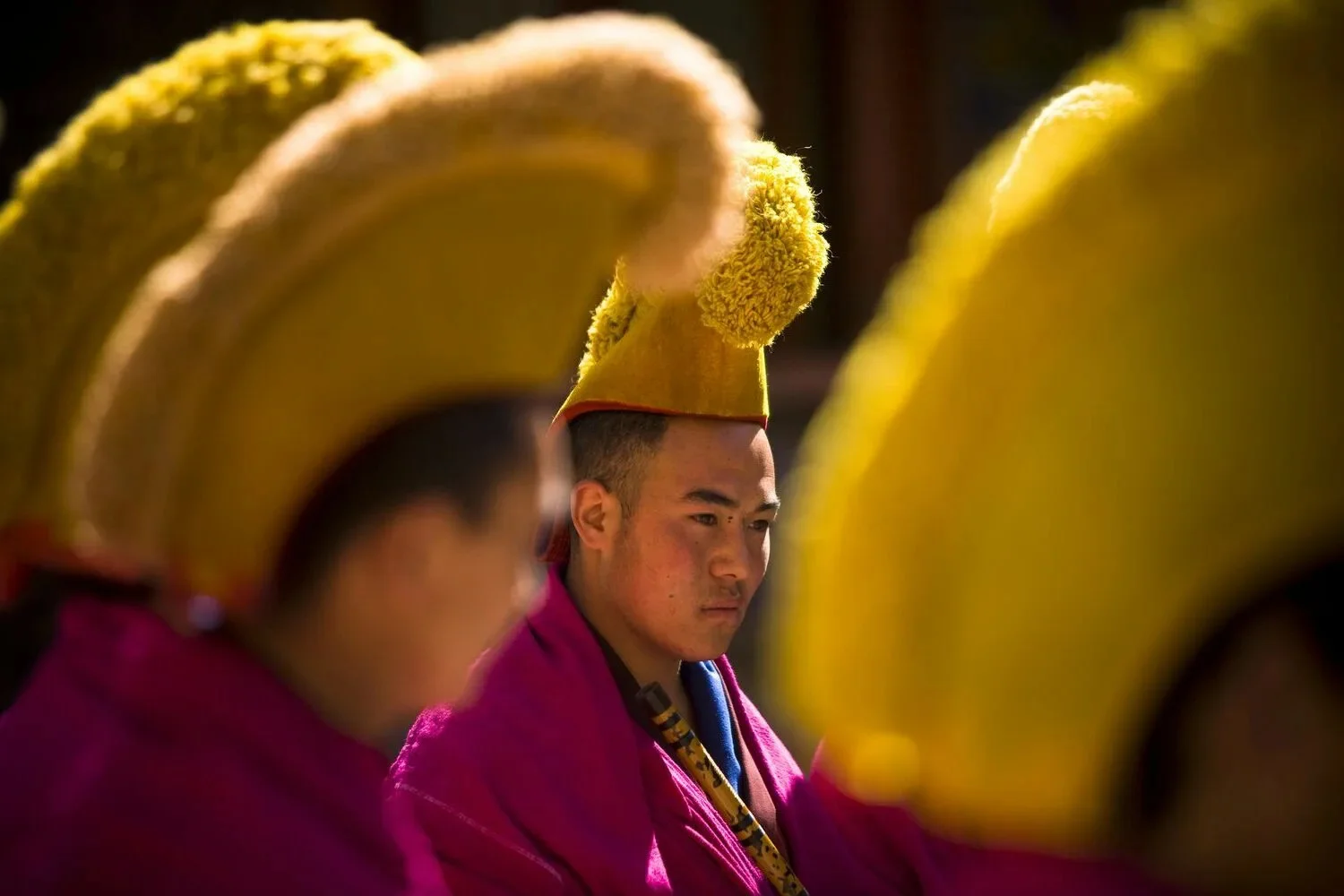
Schools of Tibetan Buddhism: Nyingma, Kagyu, Sakya, and Gelug
How the Nyingma, Kagyu, Sakya, and Gelug schools of Tibetan Buddhism differ: history, teachers, spiritual practices, and monasteries along travel routes in Tibet.
Kagyü—The School of Experience
Sakya—The School of Unity of Purpose and Path
Gelug—A School of Philosophy and Discipline
There are countries you know about before you’ve even seen them. You know them not with your eyes, but through that vague feeling that arises when you hear the word “eternity.” Tibet is one such place.
When you look at the roof of the world, at the snow lying so peacefully on the mountain peaks—as if it had been there not for thousands of years, but since the dawn of time—it’s hard to believe that on this harsh land, people have spent centuries debating the most subtle workings of human consciousness: what the “self” is, where suffering comes from, whether death can be overcome, and whether there is anything that remains when everything a person has come to regard as their very self disappears. And, as is always the case among those seeking a single truth, the paths to it turn out to be a garden of countless trails.
Thus, in Tibetan Buddhism, four main schools emerged—four paths within a single garden: Nyingma, Kagyu, Sakya, and Gelug. Sometimes, to someone hearing these names for the first time, it may seem as though they represent four distinct religions. But that is not the case. They are more like travelers approaching a mountain from different directions. One heads through the valley, another climbs the cliffs, a third studies the map at length, and a fourth trusts the one who has already traveled this path. The mountain, however, remains the same. And, paradoxical as it may seem, their goal is not the summit.
Nyingma—The School of Insight
Nyingma is a school of direct realization of the nature of mind. A teacher can give a student what is known as a direct introduction to the nature of mind, and the experience can indeed resemble a flash of insight: a sudden shift in perception, where a person does not receive a new thought but rather seems to see for the first time what has always been right in front of them.
The Ancient School and Padmasambhava
The word “Nyingma” itself means “ancient.” This tradition is considered the heir to the early days of Buddhism’s spread in Tibet, when, in the 8th century, the great teacher Padmasambhava brought tantric teachings to the country and integrated them with the local Bon religion. He became the first and most important guru in this land, revered in the Nyingma school as the Second Buddha.
There is something distinctly Tibetan about the image of Padmasambhava. He does not resemble a quiet philosopher sitting under a tree and pondering the nature of the world. In Tibetan legends, he goes to places where demons, mountain spirits, and forces that people fear dwell, and instead of destroying them, he brings them under the teachings. It is thanks to him that Himalayan Bon became organically intertwined with Tibetan Buddhism. People often want to destroy within themselves what they fear. But Guru Rinpoche taught otherwise. In his school, even the dark forces of the soul were transformed into tools on the path to awakening. Thus, fear was subjugated to compassion.
Dzogchen: Direct Realization of the Nature of Mind
The highest teaching of the Nyingma school is considered to be Dzogchen—“Great Perfection.” Its meaning is extraordinarily simple in words and extraordinarily difficult to put into practice. The nature of consciousness is inherently pure and free. A person seeks enlightenment just as someone sitting by a river might seek water. But knowing this intellectually does not mean seeing it. And so, a Dzogchen teacher strives not so much to explain the truth to the student as to show him the nature of his own consciousness.
The Nyingma tradition is characterized by a combination of monastic tradition, tantric practices, meditation, and a very strong lineage of hermitism. An important role in Dzogchen is played by the terma—“hidden teachings”—which, according to tradition, Padmasambhava and his disciples left for future generations and were later discovered by tertons—“treasure revealers”. Therefore, the Nyingma is viewed as a school in which ancient teachings are constantly being rediscovered at just the right moment.
Unlike the Kagyu tradition, which places greater emphasis on yogic methods and mahamudra (the highest spiritual teaching), the Nyingma tradition particularly emphasizes the direct recognition of the nature of mind through the teacher’s instruction and subsequent meditation. The Kagyu tradition often leads to the nature of mind through practice and the transformation of energy, while the Nyingma tradition, through Dzogchen, seeks to immediately reveal that space of consciousness in which all these thoughts, fears, and desires already arise and dissolve. Thus, “insights” in Dzogchen are an important element of cognition.
National team
In the Nyingma tradition, a terma is not simply a sudden flash of insight or a lucky idea, like a business insight. Terma literally means “treasure.” Sometimes these were physical texts or objects hidden in rocks, and sometimes they were “treasures of the mind,” when the teachings were revealed directly in the tertön’s consciousness.
A terma is like a flash of insight that is experienced not as one’s own invention, but as the discovery of knowledge that already existed. An ordinary person would say, “I had an idea.” Within the tradition, a tertön would be more likely to say, “What was hidden and intended for this time has been revealed to me.” Therefore, the truth may manifest before humanity is ready to understand it. It is as if it “hides” until the right circumstances arise and a person capable of revealing it to others appears. To put it in completely modern terms, a terma is more of an “actualization of hidden knowledge” than simply an insight.
In ancient Tibetan culture, there were indeed mediums, rituals for communicating with spirits, and a conception of the sacred landscape. In the legends of Padmasambhava, local deities and spirits are “tamed” and transformed into protectors of the Dharma. The Tibetan landscape itself (caves, lakes, mountains) thus becomes a place where sacred knowledge may be hidden. Therefore, the idea that “the teaching is hidden in the world and is revealed to the chosen one at the right moment” fit very naturally into Tibetan culture.
Now every traveler to Tibet takes comfort in the thought that his own epiphany might be part of a greater body of knowledge. If you approach this with care and without fanaticism, then perhaps your personal “terma,” received in Tibet, may well provide you with something useful in your future life. Ordinary moments of insight haven’t gone anywhere, especially in this part of the world.
Nyingma Monasteries Along the Routes
(The Golden Triangle of Tibet, Everest Base Camp, the pilgrimage route around Mount Kailash)
● Samye is the first Buddhist monastery in Tibet, founded in the 8th century. It is located in the Yarlung Valley, approximately 120 km southeast of Lhasa. Originally, it was the spiritual center of the Nyingma school, but today it is a shared sacred site where monks from various traditions can be found. It is jointly administered by the Nyingma and Sakya schools.
● Rongbuk is the highest-altitude monastery in the world, located near Everest Base Camp.
● Chiu Gompa—33 kilometers south of Darchen, near Lake Manasarovar and the hot springs. The main spiritual center of the Nyingma school in Western Tibet.
Kagyü—The School of Experience
While the Nyingma preserves the memory of antiquity, the Kagyu—like many yogic schools—focuses primarily on practice. It is known as a tradition of oral (and sometimes physical) transmission. The teacher transmits to the student not merely a system of ideas, but also living experience. One of the greatest heroes of this tradition was the yogi Milarepa. His story is extraordinary precisely because it does not begin with holiness. According to legend, Milarepa became a murderer in his youth, practiced black magic, and caused great harm to people. Later, horrified by what he had done, he set out to find the path to liberation. His teacher, Marpa the Translator, subjected his student to almost unbearable trials. He forced him to build stone towers, only to tear them down and rebuild them again. In this way, a person often carries within himself such a heavy burden of his own past that no amount of reasoning can set him free. He must travel a long path of toil, pain, and humility before he ceases to be the person he once was.
Later, Milarepa became one of Tibet’s most revered yogis. He lived in mountain caves, meditated, and composed songs about the freedom of consciousness. It was in the Kagyu schools that the practices of inner yoga became a central part of the path, particularly through the lineage of Tilopa → Naropa → Marpa → Milarepa → Gampopa.
The Six Yogas of Naropa
The key set of Kagyu practices is called the “Six Yogas of Naropa.” This is a system of advanced tantric meditation in which the body, breath, and mind are used as a unified path to experiencing the nature of mind. These include: tummo—inner fire; the illusory body—the experience of the relativity and impermanence of phenomena; dream yoga—maintaining awareness during sleep; clear light—working with the subtlest states of consciousness; bardo yoga—the practice of mindfulness in the intermediate state between death and rebirth; and phwo—the transfer of consciousness at the moment of death. All these methods are aimed not at acquiring extraordinary abilities, but at making the mind so clear and stable that one can directly perceive its true nature.
Tumo is particularly famous in the Kagyu tradition thanks to Milarepa. In Tibetan hagiographies, he is depicted as a yogi capable of meditating in mountain caves, practically naked, in the bitter cold. But it is important to understand that tummo is not a “breathing technique for warming up.” The heat in the body is considered merely a side effect. The main goal is much deeper. The practitioner works with what is called the “subtle body” in Tibetan tantra: the energy channels—tsa, the winds or energies—lung, and the drops—tigle. Through postures, breath retention, visualization, and concentration, practitioners seek to gather the “winds” in the central channel. From the perspective of the tradition itself, this alters the usual way the mind functions and opens access to its more subtle levels.
The Kagyu School is often regarded as the most “yogic” of the four major schools of Tibetan Buddhism. Complex tantric practices also exist in the Nyingma, Sakya, and Gelug traditions, but in the Kagyu tradition, the image of the hermit yogi—who spends years in retreat and verifies the teachings through personal experience—truly holds a special place. Milarépa has become almost the archetype of the Tibetan yogi. Not a scholar surrounded by libraries, but a man in a cave who practices tummo, meditates on the nature of mind, and turns his own life into a laboratory.
The Nature of the Mind Through Experience
Then the logic behind the entire Kagyu school system becomes clear:
Body → breath → energy → consciousness → the nature of consciousness.
Tumo is not the goal here. Neither is dream yoga. Even the ability to remain conscious at the moment of death is not the main point. All these practices serve only one purpose: to allow a person to directly perceive what is called the nature of mind in Mahamudra. That is why Milarepa remained in the icy cave—not out of a desire to prove his resilience. The cold was merely an external condition. The real experiment was taking place within him.
Kagyü is a direct—one might even say physical—exploration of the nature of the mind, in which a person observes how thoughts, emotions, and the very sense of “I” arise and disappear, and tries to discover who supposedly controls all of this. A thought arises, but from where? It vanishes, but where to? Anger, fear, joy, and memories fade away; the body and personality change, yet we still say, “This is me.” Mahamudra does not claim that the person does not exist; it shows that a stable, unchanging “self” cannot be found as a separate entity. And then attention shifts from the thoughts themselves to the awareness in which they arise and disappear. It is precisely this direct recognition of the nature of consciousness that becomes the heart of the practice.
Kagyü Monasteries on the Three-Day Kora Route Around Mount Kailash
● Chuku is the first monastery along the route, built on a steep cliff. Its main sacred objects are considered to be the spontaneously appeared marble statue of Buddha of Boundless Light, the ancient copper cauldron of the yogi Naropa, and Milarepa’s snow-white shell.
● Dirapuk—the site of the pilgrims’ first overnight stay—is associated with the name of Gotzangpa, the discoverer of the sacred Kora. The monastery was built around the great master’s meditation cave. The monastery’s windows offer the closest and most impressive view of the northern face of Kailash.
● Zutulpuk—the name of the monastery translates as “Cave of Miracles,” as it stands above a grotto where Milarepa meditated and competed in magic with a Bon shaman. Travelers spend the night here before the final trek to Kore.
Sakya—The School of Unity of Purpose and Path
The Sakya School originated in the 11th century and took its name from the Sakya Monastery, founded in 1073 by Khyen Khyongchog Gyalpo on land of an unusual grayish-white color. The Sakya spiritual lineage is associated with the Indian mahasiddha Virupa, to whom tradition attributes the transmission of the Lamdre teachings, known as “The Path and Its Fruit.” This very title encapsulates an idea that seems simple only until one tries to apply it to one’s own life.
Rod Khyon: Family Succession at School
The Sakya School has one distinctive feature that is unusual even for Tibet. For many centuries, its history has been linked to the Khyong clan. In other schools, great teachers, abbots of monasteries, or recognized reincarnations of past masters could rise to leadership positions. In Sakya, however, spiritual succession was long intertwined with family succession. Teachers, hierarchs, and lineage holders all came from the same clan. Therefore, religion here was passed down not only from teacher to student, but also from generation to generation, as if, along with the family name, a person was entrusted with the duty to preserve what had been entrusted to their ancestors.
The highest-ranking leader of the tradition bears the title Sakya Trizin, which literally means “holder of the throne of the gray earth.” Historically, this title has remained within the Khyen family. There is something almost contradictory about this. Buddhism teaches that all things are impermanent, and that it is impossible to hold onto possessions, one’s name, one’s status, or even one’s body. And yet, the tradition itself has been preserved within a single family for centuries. But perhaps there is no contradiction here. The family here was not the owner of the teachings, but their temporary custodian. A father passed on to his son not the right to possess the truth, but the duty not to lose it.
The Five Great Masters of the Sakya School
The Five Great Masters of the Sakya School hold a special place in the school’s history. Sachen Kunga Nyima laid the foundations of the tradition and is associated with the famous teaching on liberation from the four attachments. His sons, Sonam Tsemo and Jetsun Dragpa Gyaltsen, continued their father’s philosophical and tantric lineage. Then came Sakya Pandita Kunga Gyaltsen, one of the greatest scholars of medieval Tibet, a man for whom faith did not preclude the need to think, debate, and test his own understanding. His nephew, Drögön Chogyal Phagpa, became the spiritual mentor of Kublai Khan. Thanks to this relationship, the Sakya gained immense political influence, and Tibetan Buddhism came to occupy an important place at the Mongol court and within the Yuan dynasty.
And so the school that taught liberation from attachments found itself alongside the greatest power of its time. Its lamas conversed with khans, participated in politics, and served as intermediaries between Tibet and the Mongol rulers. And this, too, was a test of the teachings. It is easy to talk about impermanence in a cave. It is much harder to keep it in mind when a sovereign bows before you and lands and people may depend on a single word from you.
Lamdre: “The Path and the Fruit”
But the most important thing about Sakya is neither power nor the history of the Khyong clan. The most important thing lies in the Lamdre teachings.
The path and the fruit. People are accustomed to separating these two things. First, they study; then they hope to become educated. First, they work; then they want to be happy. First, they endure; then, they promise themselves they’ll start living. They say they’ll endure a little longer, achieve something else, solve a problem, finish a task, earn enough money—and then real life will begin.
But ten years go by. Then twenty. Then thirty. One day, a person looks back and realizes, to their surprise, that there was no other life. All those years, which they had considered a time of preparation, were, in fact, their life.
In this sense, the Lamdre teaching makes an almost ruthless point. The fruit does not lie somewhere at the end of the road. You cannot walk the wrong path your whole life and hope that the truth will suddenly appear with your final step. The quality of consciousness to which a person aspires must begin to manifest little by little right now. Seeking compassion? Let it arise in your attitude toward others today. Seeking freedom? Start noticing your attachments. Seeking clarity? Learn to see your own self-deception before you speculate about the nature of reality.
At the heart of the Sakya tantric tradition lies the Hevajra Tantra. Through it, Lamdre integrates work with the body and mind, visualization, meditation, a philosophical understanding of emptiness, and the transformation of habitual perception. But the goal of these practices is not to acquire extraordinary abilities. It is human nature to turn even the spiritual path into a kind of competition. One craves money, another fame, a third power, and a fourth seeks mystical experiences. The object of desire may change, but the very desire to stand out and be special remains the same.
Sakyamuni seeks to show that even the mind, which is currently deluded, already contains the potential for liberation. Delusion, the path, and the fruit all unfold within a single human mind.
Therefore, a person does not need to destroy their former self and create some new, perfect person in its place. They need to see how they themselves create their own fears, attachments, and self-concepts. What was once a cause of suffering can, with the right understanding, become the building blocks of the path.
People usually ask where the path is leading them. Sakya offers a different question: “What happens to you as you walk?” Because if the path doesn’t change a person today, it’s hard to see why it should change them tomorrow. The fruit isn’t waiting for you somewhere at the end of the road. If the path is genuine, the fruit is already ripening with every step.
Sakya Monastery
The school’s main residence and historic heart are located 130 kilometers southwest of the city of Shigatse. The monastery was founded in 1073 and looks less like a typical Tibetan temple and more like a mighty medieval fortress with towers and a moat. Its walls are painted in the school’s traditional colors—dark gray with vertical white and red stripes. The monastery houses Tibet’s greatest library—a massive wall filled with ancient sacred scrolls and manuscripts. In total, it contains about 84,000 manuscripts, including Sanskrit texts written in gold letters.
Gelug—A School of Philosophy and Discipline
It is the youngest of the four major schools of Tibetan Buddhism. It emerged at the turn of the 14th and 15th centuries thanks to Tsongkhapa, who sought to restore rigor to Buddhist practice: monastic discipline, in-depth study of philosophy and logic, and consistent progress along the path. While the Nyingma school says, “Recognize the nature of mind,” the Kagyu school says, “Experience it through practice,” and the Sakya school says, “See how the path already contains the fruit within itself,” then Gelug seems to urge: “First, learn to think clearly and master yourself.” That is why its monasteries became vast intellectual centers, resembling philosophical academies. Here, for years, students studied texts, logic, and emptiness, and the famous monastic debates were a way to teach people not merely to defend their opinions, but to uncover errors in their own thinking.
"The School for Rulers"
It was from within the Gelug tradition that the institution of the Dalai Lama emerged, and in the 17th century, the Fifth Dalai Lama consolidated both spiritual and secular authority in his own hands. Beginning in 1642, the Ganden Phodrang government became the central political system of Tibet, and the Gelug school became more closely tied to the state than the other schools. Therefore, metaphorically speaking, it can indeed be called the “school of rulers”: the monks and lamas of this tradition were not only teachers of meditation and philosophy, but also figures involved in the governance of the country, diplomacy, and political power.
However, there is an important paradox here. Formally speaking, the Dalai Lama is not even the head of the Gelug school—the highest holder of its lineage is considered to be the Ganden Tripa, the “holder of the Ganden throne.” Therefore, it is entirely incorrect to equate the Gelug school, the Dalai Lama, and the Tibetan state. Moreover, religious and political authority within the tradition itself have at times been at odds. The history of Gelug reveals a curious fact: a school that initially placed special emphasis on monastic discipline and liberation from worldly attachments ultimately found itself at the very center of worldly power. And therein, perhaps, lies its most human characteristic. To govern others, a person must first learn to govern their own mind—anger, desires, fear, and self-confidence.
Therefore, the Gelug ideal is neither a mystic awaiting a sudden revelation nor merely a yogi sitting in a cave. It is a scholar-monk who, for decades, trains the ability to think, question, and examine his own beliefs. And it was from this very tradition that a system historically emerged which, for several centuries, was linked to the governance of Tibet.
Monasteries Along the Routes
● Drepung (on the outskirts of Lhasa) — at the height of its glory, it was the largest monastery in the world (with up to 10,000 monks). It is home to the Ganden Phodrang Palace—the first residence of the Dalai Lamas before they moved to Potala.
● Sera (on the outskirts of Lhasa) is famous for the monks' daily philosophical debates in the inner courtyard.
● Tashilhunpo (Shigatse) is the historic seat of the Panchen Lama—the second-most important spiritual leader of the Gelug school and of all Tibet. The monastery was founded in 1447 by the First Dalai Lama. Inside is the world’s largest gilded statue of Maitreya Buddha.
● Pelkor Chode (Gyantse, on the way to the Everest and Kailash base camps) is the only monastery in Tibet that brings together several schools. In the main assembly hall stand two identical thrones—one for the Dalai Lama (Gelug) and one for the head of the Sakya school. People come here to see the famous Kumbum Stupa (which translates to “100,000 Images of the Buddha”). It is a multi-story white chorten with 108 gates and dozens of inner shrines, whose walls are adorned with ancient murals in the Nepalese and Tibetan styles.
Different Paths
People like to ask which school of thought is closer to the truth. But this question probably stems from the same human weakness that gives rise to disputes between religions. It’s not enough for a person to follow their own path; they also want to prove that someone else’s path is worse.
The Nyingma School urges: “Behold the original nature of consciousness.” The Kagyu School instructs: “Experience the truth through your own practice.” The Sakya School teaches: “Understand the path and the goal as one.” Gelug demands: “Discipline your mind and do not accept anything simply because you want to believe it.” And all of them echo the same teaching of the Buddha, which has endured through empires, wars, and the disappearance of entire peoples: human beings suffer because they mistake the impermanent for the permanent, and what does not belong to them for their own. He says: “My life. My body. My success. My love. My country. My faith.”
Time passes, and one by one, these things fade away. And then the question remains—the same one that Tibetan monks have asked themselves amid the wind and snow for many centuries: If everything I call “myself” changes, then who am I?
We will find the right route for you
Tell us what interests you, and a destination expert will get in touch, answer your questions about altitude, dates and preparation, and suggest a suitable programme. The consultation is free and commits you to nothing.
Request received
A destination expert will get in touch within one business day.