

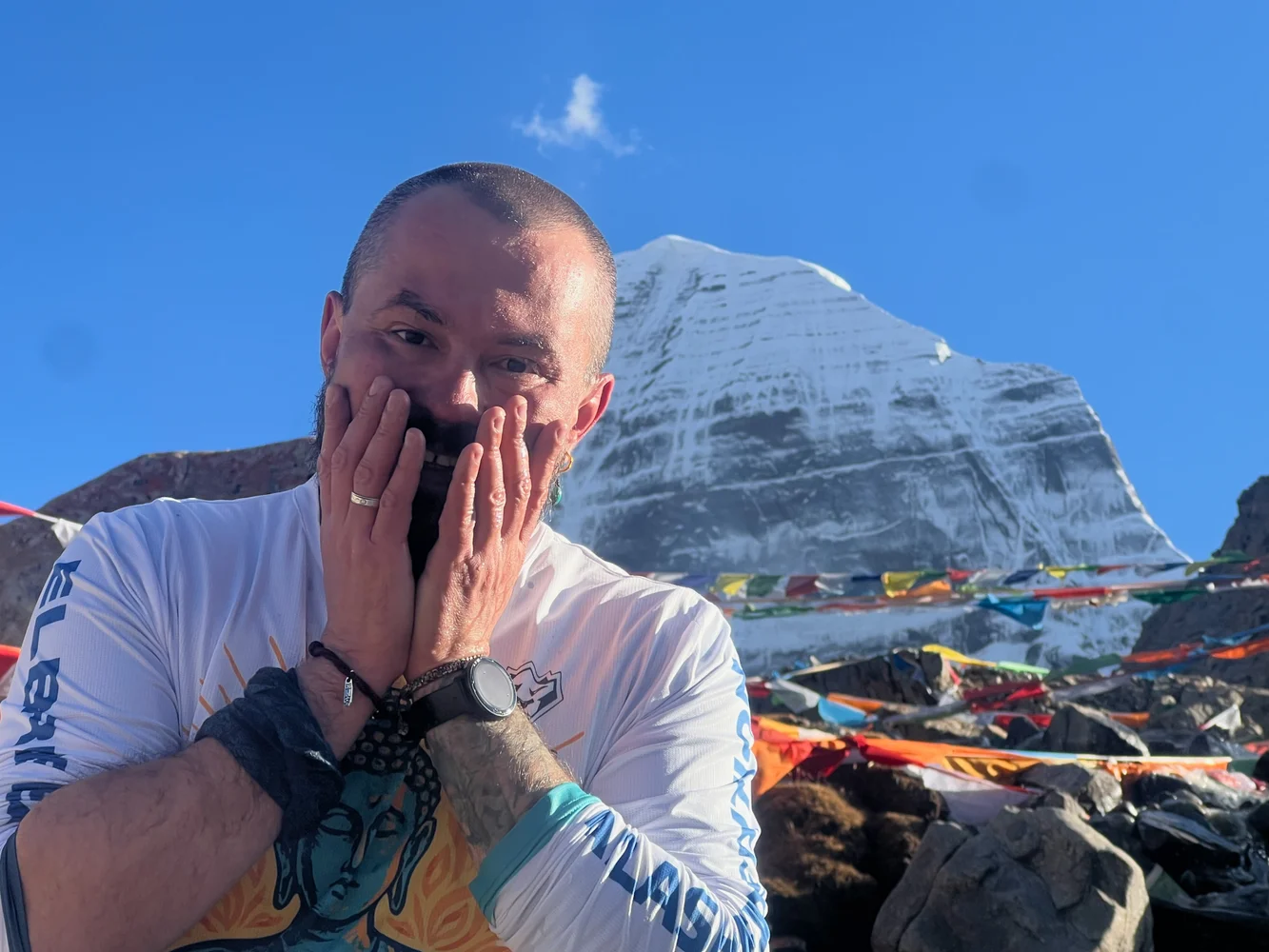
Therma on the Road: A Guide to “Enlightenment” in Tibet
What is a “therma” in Tibetan Buddhism, and who are the “tertons”? How does the tradition of “hidden treasures” help us gain a deeper understanding of Tibet, the crust of Mount Kailash, and ourselves.
What Is a Terma, and Why Did Tibet Turn the Landscape into a Book?
How Treasure Hunters Discovered Treasures in the Past
Where might your “therma” be located along the route?
Brief Explanation
In Tibetan Buddhism, “terma” refers to a special tradition of discovering hidden spiritual “treasures” (texts, revelations, or relics) that were hidden in the past and discovered at the appropriate time by tertons—recognized discoverers of the “treasures” of Buddhist teachings.
A terma is not merely a good idea, a chance discovery, or a sudden flash of inspiration. According to the traditional explanation of the Nyingma school, such teachings and objects were concealed—primarily by Guru Padmasambhava himself and his entourage—only to be revealed later at the appropriate historical moment. Academic research views terma simultaneously as a form of religious revelation, a means of legitimizing new texts, and a unique perspective on the Tibetan and Himalayan landscape as a repository of the past.
A word of caution. We use this term intentionally, but not literally. In this guidebook, the expressions “your terma,” “finding a terma along the way,” and “the traveler’s epiphany” are nothing more than literary and practical metaphors denoting the intention and meaning of the journey. We do not equate a tourist with a tertön, ordinary psychological insight with religious revelation, or a hike with a tantric practice. For Nyingma believers and Bon followers, the terma is part of a living sacred tradition. In no way do we intend to mock, devalue, or appropriate this tradition through our text. On the contrary, a good metaphor begins when one understands its limits.
On the trail or in the wilderness, a traveler doesn’t need to search under every rock for a scroll by Padmasambhava. It’s much more interesting to ask what “hidden treasure” the journey itself reveals. It may turn out to be an understanding of your own fear at a mountain pass, the unexpected kindness of a stranger, the ability to calmly endure the rain, the silence in a monastery courtyard, or the simple realization that for the past three hours, you’ve been thinking only about coffee.
The main idea behind this guidebook is simple. Historically, a tertön sought out something that, according to tradition, had been hidden until a certain time. The modern traveler may not be searching for a sacred tertön, but rather for something hidden within themselves—something invisible until the journey forced them to see it.
And there’s one more rule worth remembering before you set out. If you find an ancient scroll, a statuette, or a ritual object in a cave—it’s not your “therma.” In that situation, you need to stop acting like a poet, leave everything alone, and contact the guardians of the site.
What Is a Terma, and Why Did Tibet Turn the Landscape into a Book?
The word gter ma is usually translated as “treasure.” Scholar Janet Gyatsö has shown that the Tibetan terma tradition became a means for the emergence of new authoritative texts even after the great era of translations of Indian Buddhism into Tibetan. According to the Nyingma tradition, Padmasambhava and other teachers of the Tibetan Empire era concealed teachings for future generations, and the tertön designated for this purpose was to uncover them when they were most needed. At the same time, Gyatsö emphasizes that these treasures were created and recognized by both the Buddhist and Bon communities, which influenced one another.
The landscape in this depiction is particularly interesting. The cliff, the temple, the gorge, and the hidden valley can be perceived as places where the past continues to be present. In academic research on Tibetan treasures, this is described as a special form of “materialization of the past,” in which teachings and sacred objects are believed to be hidden within Tibetan and Himalayan spaces until the right time comes and the right person appears. Moreover, historically, the concept of “treasures” could include not only texts but also ritual objects, images, relics, medicines, dances, and even entire hidden lands.
This is precisely why the concept of terma fits so well with travel. Here, the route becomes a way of reading the landscape. A modern tourist typically looks at a map and sees Point A, a mountain pass, a place to spend the night, and Point B. A pilgrim may perceive the same landscape differently. A place possesses history, memory, and a connection to spiritual teachers. Pilgrimage transforms geography into an experience. Studies of the Tibetan sacred landscape show that remoteness, mountains, and places of practice continue to play an active role in contemporary Tibetan religiosity.
Here's the first useful tip for travelers.
Don't just ask the tour guide what there is to see here. Ask (including yourself) what this place has to offer in terms of what you can discover about yourself.
Earthly Treasures and Treasures of the Mind
In traditional classifications, it is particularly useful to distinguish between two types. Earth termas (sa gter, or sater) are associated with the physical discovery of texts and objects. Mind termas (dgongs gter, or gongter) are revealed in the mind of the tertön. More complex classifications also include re-discovered treasures, recollections, pure visions, and oral lines of revelation; therefore, it would be inaccurate to automatically label any vision a “mind terma.” The Tibetan tradition itself distinguishes between these modes of transmission quite carefully.
In terms of the travel metaphor, this yields two excellent categories.
· “The Traveler’s Earthly Terma” is that which comes from outside. You rounded a bend and saw the valley. You met an old pilgrim, heard a prayer, and read an inscription. You saw the locals repairing a bridge, or suddenly understood how life works in the place you had arrived at.
· “The Traveler’s Mind Terma” is what is unexpectedly discovered within. For example, after four hours of climbing, a person realizes that their famous love of solitude exists perfectly well—as long as someone else is carrying the heavy backpack.
What about Bon?
It is particularly important here not to equate Bon with the term “shamanism.” Contemporary scholarship on Bon reveals a far more complex history. The tradition of treasure revelations also became significant within Bon, and Tibetologist Dan Martin’s monograph is devoted specifically to the life and controversial legacy of Shenchen Luga—the 11th-century Bon discoverer of scriptures. The existence of parallel Buddhist and Bon treasure traditions, as well as the mutual debates and influences between them, have been well documented by researchers.
Therefore, the terma is not interesting as evidence that one religion “borrowed” something from another. It is far more interesting to see here a Tibetan cultural concept, according to which truth can be connected to time, a person, and a place, and can be revealed when these three elements come together. For a traveler, this is almost a ready-made formula for an itinerary: place + the right moment + an observant person = the opportunity to see something. It doesn’t have to be supernatural. Sometimes it’s enough just to see oneself.
How Treasure Hunters Discovered Treasures in the Past
Let’s clear up one common misconception right away. It’s wrong to imagine that in ancient Tibet there was a special squad of monks armed with pickaxes who went from cave to cave asking if Padmasambhava was there.
Tertons were not necessarily monastics. The Treasury of Lives biographical database defines tertons as people who uncovered scriptures or objects through visions, memory, or physical extraction. Among them were monastic teachers, yogis, and laypeople—both men and women. The famous Pema Lingpa, for example, was trained as a blacksmith. Jomo Menmo was a female tertön of the 13th century.
And the “treasure hunt” itself usually seemed more complicated than a casual stroll.
In traditional biographies, a future tertön might receive a prophecy, a dream, a vision, a special sign, or a clue to a location. There might be a sort of clue or description of the future discovery. This was followed by religious training and study of texts or symbolic writing. Afterward, the person would travel to a specific location, which might be a cave, a rock, a temple, a lake, or another sacred space. What was discovered still had to be recognized, interpreted, revealed, and transmitted. The history of the tradition also shows that the question of the authenticity of the termas was important to the Tibetans themselves and was discussed long before the emergence of modern academic skepticism. Interestingly, a modern traveler can adopt nearly the same structure without incorporating any elements of religious practice.
Question → Preparation → Journey → Attention → Insight → Real-life test.
This is exactly the approach we teach at our school for conductors.
Four Short Stories About Great Treasures
Pema Lingpa and the lake where tourists shouldn't go diving.
Pema Lingpa, who lived in Bhutan during the 15th and early 16th centuries, trained as a blacksmith and became one of the most famous tertöns. The site of Mebar Tso, known as the Burning Lake, is associated with a traditional account of how he entered the water and retrieved a treasure from it. In a later version of the story, in front of skeptical witnesses, he entered the water with a burning oil lamp and returned with the treasure, while the lamp continued to burn. A contemporary Bhutanese travelogue shows that this story remains part of the pilgrimage experience at the site to this day.
For the traveler, the moral of the story is surprisingly practical. Not everything a saint did in his life serves as a guide for tourists. Especially jumping into a mountain river.
Jomo Menmo and the Beneficial Shattering of Stereotypes.
Jomo Menmo, who lived in the 13th century, is counted among the recognized Nyingma tertons; her biography is linked to Guru Chowang, one of the famous early treasure revealers. The very fact of her presence in the tradition serves as a reminder that the image of a tertön cannot be reduced to that of a male monk sitting in a monastery library.
For the traveler, the lesson is even simpler. If you decide in advance what the person who will offer an important idea should look like, you might simply miss half of your important encounters.
Guru Chovang and Medieval Fact-Checking.
Guru Chowang, who lived in the 13th century, was one of the greatest early tertöns. Janet Gyatsö’s research shows that even then, the treasure tradition was grappling with the issue of authenticity, and texts associated with Guru Chowang discussed the signs and criteria by which an authentic discovery could be distinguished from a dubious one.
This is very good news for people today. Even in the world of revelations, the question remained: “How do we know this is true?” So if, after two hours at an altitude of 4,500 meters, you come up with a comprehensive explanation of how the universe works, you can jot it down in your notebook. But it’s best to draw your final conclusions after breakfast.
Jigme Lingpa and the Treasure That Doesn't Need to Be Dug Up.
Jigme Lingpa, who lived in the 18th century, is considered a Nyingma tertön and is associated with the discovery of the Longchen Nyingtik cycle. He found it within himself. This was precisely a moment of religious insight—the very “mind terma,” in which the discovery is associated not with extracting an object from a rock, but with an inner revelation and the subsequent transmission of the teaching.
For travelers, this leads to a wonderful "anti-Instagram" rule. Sometimes, the most important thing you’ll bring back from a trip can’t be captured in a photo.
Was the kora around Kailash a way to search for termas?
Kora is a ritual circumambulation of a sacred place or object—a form of pilgrimage. It would be wrong to turn it into a standard “treasure-hunting technique.” However, terma and kora coexist within the same cultural sphere. Both practices assume that certain places may hold special religious significance, and that a person’s movement through a sacred landscape can alter their perception. Therefore, there may be a site associated with a tertön or a terma on the kora or even along the path leading to it, but the kora itself is not a Tibetan version of a “treasure hunt.” It’s best to keep this distinction in mind, especially when walking alongside people for whom this is not a cultural excursion but an act of prayer.
Where might your “therma” be located along the route?
The most interesting thing about traveling happens the moment you stop expecting a revelation. On a real journey, it has an annoying habit of showing up where you least expect it. You paid to see the sunrise over the Himalayas, but your biggest revelation came near the restroom at the second rest stop. That’s just how it goes.
As a guide, I’d like to suggest a simplified but very practical approach to preparing your mind for any journey. It consists of three parts. We go into more detail at the guide school.
A Question at the Start
Start at the very beginning, when you’re still fresh and energetic, your backpack is packed perfectly, the photos are beautiful, and it feels like you’re setting out “to find yourself.” Ask yourself one question: “What do I want to get out of this journey?” And then a second: “What if the journey gives me something completely different?” This will be your first mindfulness exercise.
Thirty seconds of inactivity
At a sacred cave, a modern person’s first impulse is very simple—to take a photo—and the second is even simpler—to pick up a small stone as a souvenir. And that’s normal, but this is where a wonderful practice comes into play. Do nothing for thirty seconds. Just look. What happens when a place exists not as a backdrop for your photo, but in and of itself? This can become your metaphorical thermae. The ability not to appropriate.
To see a person
Sometimes the most significant event of the day isn’t a place, but a person. You see an elderly woman walking more slowly than you. An hour later, you pass her. Two hours later, you’re sitting there, exhausted, while she calmly walks right past you. You don’t necessarily have to jump to the conclusion that traditional wisdom is superior to your way of life. A journey in the mountains is already quite good at humbling human pride.
On the trail around Kailash, for example, researchers observed pilgrims walking the route multiple times. Some performed the circumambulation while prostrating themselves repeatedly. In the same area, Buddhist and Bon pilgrims follow different directions on their circuits. This reminds tourists that the same trail may be just a path for them, but a sacred road for the person next to them. Therefore, there is one rule here: before you take a photo of someone, try simply to see them.
And here’s another myth worth debunking. The intensity of an emotion is a poor measure of true insight. A much more accurate test is this: will anything still stick with you a month from now? That’s why it’s helpful to jot down three more lines after your trip.
What I saw.
What I've learned about myself.
How will this change my behavior at home?
If the third line is blank, perhaps it was just a beautiful moment of reflection. There’s nothing wrong with that. Not every cloud has to be a revelation.
Map of places where "therma" can be found
This is not a map of religious termas. It is a diagram of possible moments of personal discovery.
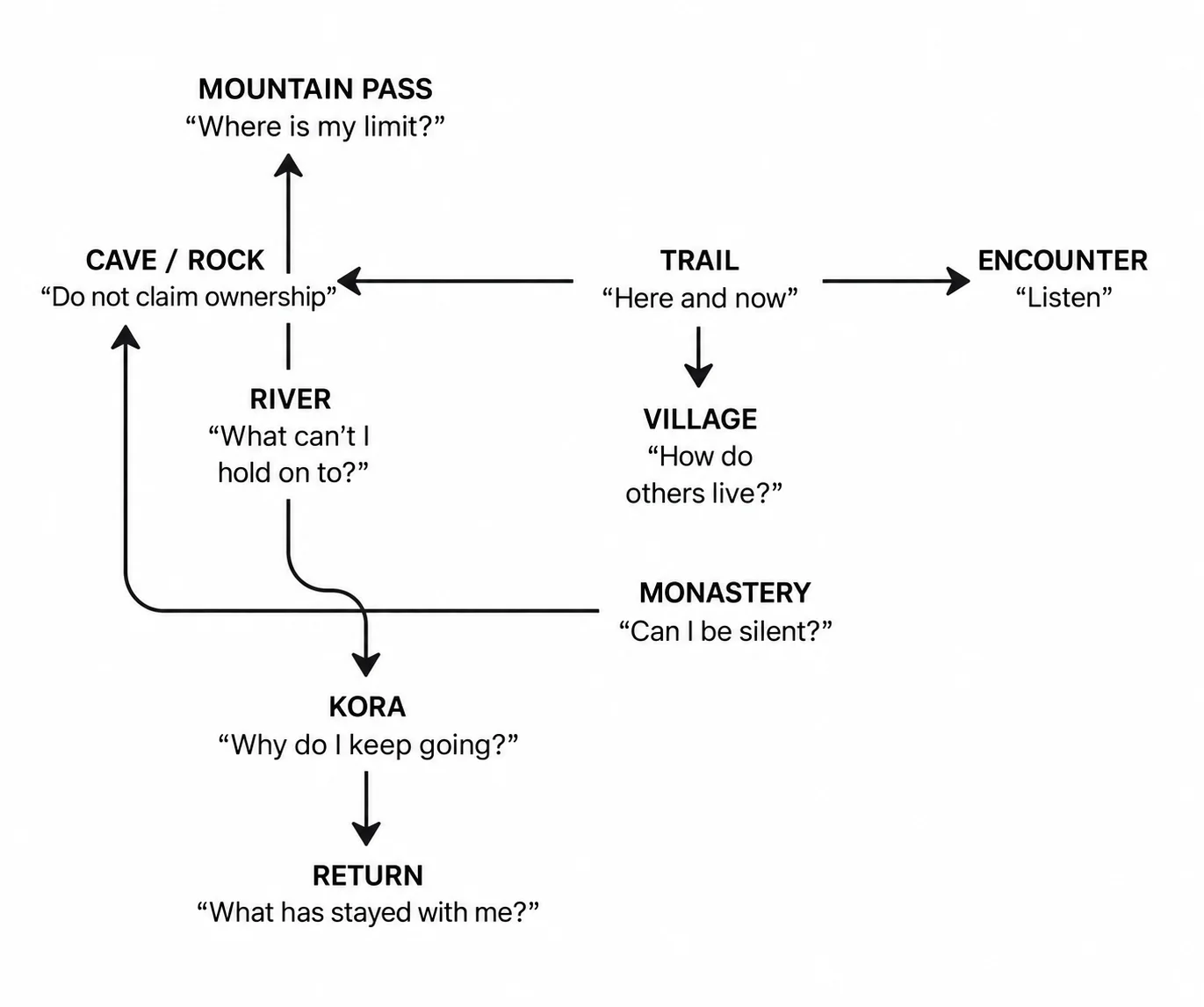
Notice a strange feature of this map. It doesn’t have an “INSIGHT” marker. That’s because if you designate a spot for insight in advance, it turns into a tourist attraction. But true discoveries don’t play by a schedule.
We will find the right route for you
Tell us what interests you, and a destination expert will get in touch, answer your questions about altitude, dates and preparation, and suggest a suitable programme. The consultation is free and commits you to nothing.
Request received
A destination expert will get in touch within one business day.