

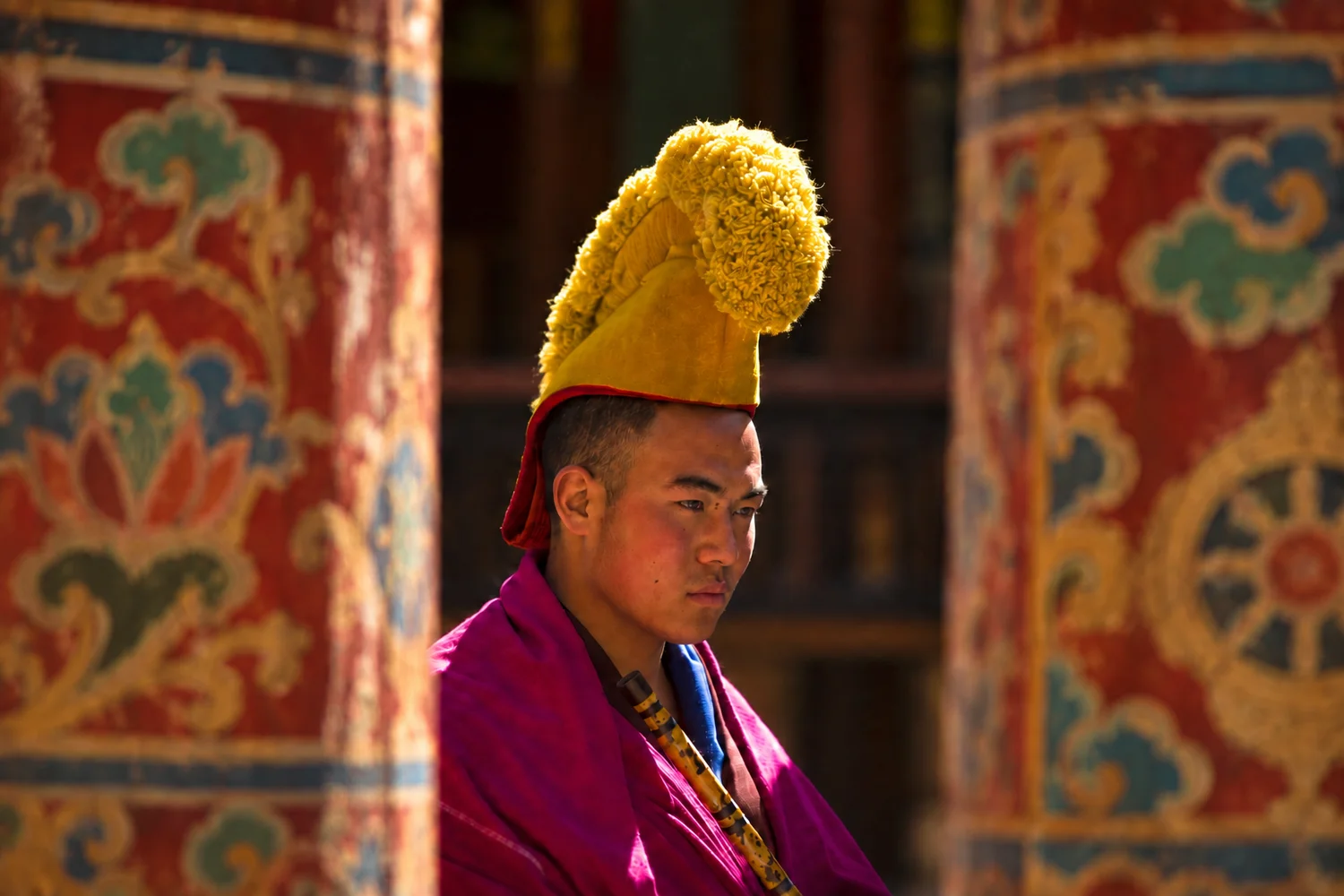
The schools of Tibetan Buddhism: Nyingma, Kagyu, Sakya and Gelug
How the Tibetan Buddhist schools of Nyingma, Kagyu, Sakya and Gelug differ: history, teachers, spiritual practices and the monasteries on travel routes in Tibet.
Nyingma — the school of insight
Kagyu — the school of experience
Sakya — the school of the unity of goal and path
Gelug — the school of philosophy and discipline
There are countries you know before you have seen them. You know them not with your eyes but with that vague feeling that arises at the word "eternity". Such is Tibet.
When you look at the roof of the world, at the snow lying on the summits so calmly, as if it had been there not for thousands of years but since the beginning of time, it is hard to believe that on this harsh land people argued for centuries about the subtlest movements of human consciousness: what the "self" is, where suffering comes from, whether death can be conquered, and whether there exists something that remains when everything a person is used to regarding as himself disappears. And, as always happens among those seeking one truth, the paths to it turn out to be a garden of many trails.
In this way, four main schools took shape in Tibetan Buddhism too, four paths of one garden: Nyingma, Kagyu, Sakya and Gelug. Sometimes it seems to someone hearing these names for the first time that he is faced with four different religions. But that is not so. They are more like travellers approaching a mountain from different sides. One heads along the valley, another climbs the rocks, a third studies the map for a long time, a fourth trusts the one who has already walked this way. The mountain, though, remains one. And, paradoxically, their goal is not the summit.
Nyingma — the school of insight
Nyingma is the school of the direct recognition of the nature of mind. A teacher can give a student the so-called direct introduction to the nature of mind, and in experience it can indeed resemble an insight: a sudden shift of perception in which a person does not receive a new thought but, as it were, sees for the first time what has always been in front of them.
The ancient school and Padmasambhava
The word "Nyingma" itself means "ancient". This tradition is considered the heir of the earliest period of the spread of Buddhism in Tibet, when in the 8th century the great teacher Padmasambhava brought tantric teachings to the country and combined them with the local Bon religion. He became the first and most important Guru on this land, revered in the Nyingma school as a second Buddha.
There is something especially Tibetan about the image of Padmasambhava. He does not resemble a quiet philosopher sitting under a tree and reflecting on the nature of the world. In Tibetan legends he goes to where demons, mountain spirits and forces that people fear live, and he does not destroy them but subdues them to the teaching. It is thanks to him that Himalayan Bon became organically interwoven with Tibetan Buddhism. A person often wants to destroy in himself what he fears. But Guru Rinpoche taught differently. In his school even the dark forces of the soul were turned into instruments on the path to awakening. Thus fear submitted to compassion.
Dzogchen: the direct recognition of the nature of mind
The highest teaching of the Nyingma school is considered to be Dzogchen — the "Great Perfection". Its meaning is extraordinarily simple in words and extraordinarily hard in life. The nature of consciousness is originally pure and free. A person seeks enlightenment the way someone sitting by a river might look for water. But to know this with the mind is not yet to see it. And so the Dzogchen teacher tries not so much to explain the truth to the student as to show them the nature of their own consciousness.
Nyingma is characterised by a combination of monastic tradition, tantric practices, meditation and a very strong line of hermit life. An important role in Dzogchen is played by terma — the "hidden teachings" that, according to tradition, Padmasambhava and his disciples left for future generations, and which were later discovered by tertöns — the "treasure revealers". Nyingma is therefore perceived as a school in which the ancient teaching is constantly revealed anew at the right moment.
Unlike Kagyu, where the emphasis falls more on yogic methods and Mahamudra (the highest spiritual teaching), Nyingma especially stresses the direct recognition of the nature of mind through the teacher's instruction and subsequent meditation. Kagyu often leads to the nature of mind through practice and the transformation of energy, while Nyingma, through Dzogchen, tries to show at once the space of consciousness in which all these thoughts, fears and desires already arise and vanish. Thus the "insights" in Dzogchen are an important element of knowing.
Terma
In the Nyingma tradition, terma is not simply a sudden flash of insight or a good idea like a business insight. Terma literally means "treasure". Sometimes these were physical texts or objects hidden in rocks, and sometimes "treasures of the mind", when the teaching was revealed directly in the tertön's consciousness.
Terma is like an insight that is experienced not as one's own invention but as the discovery of knowledge that already existed. An ordinary person says: "An idea came to me." A tertön, within the tradition, would rather say: "What was hidden and meant for this time has been revealed to me." That is why truth can appear before humanity is ready to understand it. Then it as if "hides" until the moment when suitable circumstances arise and a person able to reveal it to others. Put in quite modern language, terma is rather the "actualisation of hidden knowledge" than a mere insight.
In ancient Tibetan culture there really were mediums, rituals of communication with spirits and the notion of a sacred landscape. In the legends about Padmasambhava, local deities and spirits turn out to be "tamed" and transformed into protectors of the Dharma. The Tibetan landscape itself (caves, lakes, mountains) thereby becomes a place where sacred knowledge can be hidden. So the idea that "the teaching is hidden in the world and at the right moment is revealed to the person meant for it" fitted very organically into precisely Tibetan culture.
Now every traveller to Tibet indulges the thought that his or her own insight might be part of great knowledge. If approached with care and without craziness, perhaps your personal "terma", received in Tibet, is quite capable of giving you something useful in later life. Ordinary insights have not been cancelled, especially in this part of the Earth.
Nyingma monasteries on the routes
(The Golden Triangle of Tibet, Everest Base Camp, the kora around Kailash)
Samye — the first Buddhist monastery in Tibet, founded in the 8th century. It is in the Yarlung valley about 120 km south-east of Lhasa. It was originally the spiritual centre of the Nyingma school, but it is now a shared sacred place where you can meet monks of different traditions. It is managed jointly by the Nyingma and Sakya schools.
Rongbuk — the highest monastery in the world, next to Everest Base Camp.
Chiu Gompa — 33 kilometres south of Darchen, next to Lake Manasarovar and the hot springs. The main spiritual stronghold of the Nyingma school in Western Tibet.
Kagyu — the school of experience
If Nyingma preserves the memory of antiquity, Kagyu, like many yogic schools, speaks above all about practice. It is called a tradition of oral (and at times physical) transmission. The teacher passes to the student not just a system of thought but living experience. One of the greatest heroes of this tradition was the yogi Milarepa. His story is extraordinary precisely because it does not begin with holiness. Milarepa, according to legend, became a murderer in his youth, practised black magic and caused people great harm. Then he was horrified at what he had done and set out to look for a path of liberation. His teacher, Marpa the Translator, subjected the disciple to almost unbearable trials. He made him build stone towers, then tear them down and build them anew. A person often carries such a weight of his own past that no reasoning frees him from it. He has to go through a long road of labour, pain and humility before he stops being who he was.
Later Milarepa became one of the most revered yogis of Tibet. He lived in mountain caves, meditated and composed songs about the freedom of consciousness. It was in the Kagyu schools that the practices of inner yoga became one of the central parts of the path, especially through the lineage of teachers Tilopa → Naropa → Marpa → Milarepa → Gampopa.
The Six Yogas of Naropa
The key set of Kagyu practices is called the "Six Yogas of Naropa". It is a system of advanced tantric meditation in which the body, breath and consciousness are used as a single path to experiencing the nature of mind. They include: tummo — inner fire; the illusory body — experiencing the relativity and instability of phenomena; dream yoga — keeping awareness in sleep; clear light — working with the subtlest states of consciousness; bardo yoga — the practice of awareness in the intermediate state between death and a new birth; and phowa — the transference of consciousness at the moment of death. All these methods are aimed not at acquiring unusual abilities but at making the mind so clear and stable that a person can directly see its nature.
Tummo in Kagyu is especially famous thanks to Milarepa. In Tibetan hagiographies he is portrayed as a yogi able to meditate in mountain caves almost without clothing in severe cold. But it is important to understand that tummo is not a "breathing technique for warming up". The warmth in the body is considered merely a by-product. The main goal is far deeper. The practitioner works with what Tibetan tantra calls the subtle body: the energy channels — tsa, the winds or energies — lung, and the drops — tigle. Through posture, breath retention, visualisation and concentration, the practice aims to gather the "winds" in the central channel. From the point of view of the tradition itself, this changes the ordinary way consciousness functions and opens access to its subtler levels.
Kagyu is often perceived as the most "yogic" of the four major schools of Tibetan Buddhism. Complex tantric practices exist in Nyingma, Sakya and Gelug as well, but in Kagyu the image of the hermit yogi who spends years in retreat and tests the teaching through his own experience really does hold a special place. Milarepa became almost the archetype of the Tibetan yogi. Not a scholar surrounded by libraries, but a person in a cave who practises tummo, meditates on the nature of mind and turns his own life into a laboratory.
The nature of mind through experience
Then the logic of the whole Kagyu system becomes clear:
Body → breath → energy → consciousness → the nature of consciousness.
Tummo here is not the goal. Dream yoga is not either. Even the ability to keep awareness at the moment of death is not the main thing. All these practices are needed only for one purpose: to let a person see directly what Mahamudra calls the nature of mind. That is why Milarepa stayed in the icy cave — not out of a wish to prove his endurance. The cold was merely an external condition. The real experiment was taking place inside him.
Kagyu is a direct, one might say physical, investigation of the nature of mind, in which a person observes how thoughts, emotions and the very sense of "I" arise and vanish, and tries to find the one who supposedly controls it all. A thought appears, but from where? It vanishes, but to where? Anger, fear, joy and memories pass, the body and character change, yet we still say: "This is me." Mahamudra does not claim that the person does not exist; it shows that a stable, unchanging "I" cannot be found as a separate thing. And then attention shifts from the thoughts themselves to the awareness in which they arise and vanish. It is this direct recognition of the nature of consciousness that becomes the heart of the practice.
Kagyu monasteries on the route of the three-day kora around Kailash
Chuku — the first monastery on the way, built on a steep cliff. Its main treasures are considered to be a self-arisen marble statue of the Buddha of Boundless Light, the old copper cauldron of the yogi Naropa and the snow-white conch shell of Milarepa.
Dirapuk — the place of the pilgrims' first overnight stop, associated with the name of Gotsangpa, the discoverer of the sacred kora. The monastery was built around the meditation cave of the great master. From the windows of the monastery opens the closest and most impressive view of the north face of Kailash.
Zutulpuk — the name of the monastery translates as "cave of miracles", because it stands above the grotto where Milarepa meditated and competed in magic with a shaman of the Bon tradition. People spend the night here before the final stage of the kora.
Sakya — the school of the unity of goal and path
The Sakya school arose in the 11th century and took its name from Sakya Monastery, founded in 1073 by Khön Könchok Gyalpo on land of an unusual greyish-white colour. The Sakya spiritual lineage is linked to the Indian mahasiddha Virupa, to whom tradition attributes the transmission of the Lamdre teaching, called "the Path and Its Fruit". In this very name lies a thought that seems simple only until a person tries to apply it to his own life.
The Khön family: family succession in the school
Sakya has one feature unusual even for Tibet. Its history over many centuries is tied to the Khön family. In other schools the leaders could be great teachers, abbots of monasteries or recognised incarnations of former masters. In Sakya, however, spiritual succession was for a long time combined with family succession. Teachers, hierarchs and keepers of the lineage came from a single clan. So here religion was passed on not only from teacher to student but also from generation to generation, as though together with the family name a person was handed the duty of keeping what had been entrusted to his ancestors.
The supreme hierarch of the tradition bears the title Sakya Trizin, which literally means "holder of the throne of the grey earth". Historically this title remained within the Khön family. There is something almost contradictory in this. Buddhism tells a person about the impermanence of all things, about the impossibility of holding on to property, name, position and even the body. And yet the tradition itself could be preserved for centuries within one clan. But perhaps there is no contradiction in precisely this. The family here was not the owner of the teaching but its temporary keeper. A father passed to his son not the right to own the truth but the duty not to lose it.
The Five Great Masters of Sakya
A special place in the history of the school is held by the Five Great Masters of Sakya. Sachen Kunga Nyingpo laid the foundations of the tradition and is associated with the famous teaching on liberation from four attachments. His sons Sönam Tsemo and Jetsun Drakpa Gyaltsen continued their father's philosophical and tantric line. Then came Sakya Pandita Kunga Gyaltsen, one of the greatest scholars of medieval Tibet, a man for whom faith did not cancel the need to think, to argue and to test his own understanding. His nephew Drogön Chögyal Phagpa became the spiritual teacher of Kublai Khan. Thanks to this relationship Sakya gained enormous political influence, and Tibetan Buddhism took an important place at the Mongol court and in the Yuan state.
So a school that taught liberation from attachments found itself next to the greatest power of its time. Its lamas spoke with khans, took part in politics, and became intermediaries between Tibet and the Mongol rulers. And this too was a test of the teaching. It is easy to talk about impermanence in a cave. It is much harder to remember it when a sovereign bows before you and lands and people may depend on a single word of yours.
Lamdre: "the path and the fruit"
But the main thing in Sakya is still neither power nor the history of the Khön family. The main thing lies in the Lamdre teaching.
The path and the fruit. A person is used to separating these two things. First he studies, then he hopes to become educated. First he works, then he wants to be happy. First he endures, then he promises himself to start living. He says he will put up with it a little longer, achieve something more, solve some problem, finish one task, earn enough money, and then real life will begin.
But ten years pass. Then twenty. Then thirty. One day a person looks back and realises with surprise that there was no other life. All those years that he considered preparation were his life.
In this sense the Lamdre teaching says something almost merciless. The fruit does not lie somewhere at the end of the road. You cannot walk the wrong way your whole life and hope that truth will suddenly appear in the last step. The quality of consciousness a person strives for must gradually be showing itself right now. Are you seeking compassion? Let it arise in your relations with people today. Are you seeking freedom? Begin to notice your attachments. Are you seeking clarity? Learn to see your own self-deception before you reason about the nature of reality.
At the centre of Sakya's tantric tradition is the Hevajra Tantra. Through it Lamdre combines work with body and consciousness, visualisation, meditation, a philosophical understanding of emptiness and the transformation of habitual perception. But the aim of these practices is not to acquire unusual abilities. It is in a person's nature, in general, to turn even the spiritual path into a kind of competition. One craves money, another fame, a third power, and a fourth wants mystical experiences. The object of desire changes, but the urge to stand out and be special is all the same.
Sakya tries to show that even a mind that is deluded now already contains the possibility of liberation. Delusion, path and fruit unfold within one human mind.
So a person does not need to destroy his former self and create some new, perfect person in its place. He needs to see how he himself creates his own fears, attachments and ideas about himself. What was formerly the cause of suffering can, with right understanding, become material for the path.
A person usually asks where his road leads. Sakya offers a different question: "What is happening to you while you walk?" Because if the path does not change a person today, it is hard to see why it should change him tomorrow. The fruit does not wait for a person somewhere at the end of the road. If the path is real, the fruit is already ripening in every step.
Sakya Monastery
130 kilometres south-west of the city of Shigatse stands the main seat and historic heart of the school. The monastery was founded in 1073 and looks not like an ordinary Tibetan temple but like a mighty medieval fortress with towers and a moat. Its walls are painted in the school's traditional colours — dark grey with vertical white and red stripes. The monastery holds the greatest library of Tibet — a huge wall filled with ancient sacred scrolls and manuscripts. In all it contains about 84,000 manuscripts, including texts in Sanskrit written in golden letters.
Gelug — the school of philosophy and discipline
This is the youngest of the four main schools of Tibetan Buddhism. It arose at the turn of the 14th and 15th centuries thanks to Tsongkhapa, who sought to restore rigour to Buddhist practice: monastic discipline, deep study of philosophy, logic and consistent progress along the path. If Nyingma says: "Recognise the nature of mind," Kagyu: "Experience it through practice," Sakya: "See how the path already contains the fruit within it," then Gelug seems to call: "First learn to think clearly and to govern yourself." Its monasteries therefore became huge intellectual centres, reminiscent of philosophical academies. Here for years they studied texts, logic and emptiness, and the famous monastic debates were a way of teaching a person not merely to defend his opinion but to discover the error in his own thinking.
The "school of rulers"
It was from the Gelug milieu that the institution of the Dalai Lamas grew, and in the 17th century the Fifth Dalai Lama united spiritual and secular power in his hands. From 1642 the Ganden Phodrang government became the central political system of Tibet, and Gelug turned out to be more closely tied to the state than the other schools. So metaphorically it really can be called the "school of rulers": the monks and lamas of this tradition proved to be not only teachers of meditation and philosophy but also people connected with governing the country, diplomacy and political power.
Here, however, there is an important paradox. The Dalai Lama is not even formally the head of the Gelug school — the supreme holder of its lineage is considered to be the Ganden Tripa, the "holder of the throne of Ganden". Therefore it is quite wrong to identify Gelug, the Dalai Lama and the Tibetan state. Moreover, religious and political authority within the tradition itself sometimes came into conflict. The history of Gelug shows a strange thing: a school that originally placed particular emphasis on monastic discipline and liberation from worldly attachments ended up at the very centre of worldly power. And in this, perhaps, lies its most human feature. To govern others, a person must first learn to govern his own mind. Anger. Desires. Fear. Self-confidence.
So the Gelug ideal is not a mystic awaiting a sudden revelation, nor only a yogi sitting in a cave. It is the scholar-monk who for decades trains the ability to think, to doubt and to test his own convictions. And it was from such a tradition that a system historically emerged that for several centuries was bound up with the governing of Tibet.
Monasteries on the routes
Drepung (outskirts of Lhasa) — at its peak it was the largest monastery in the world (up to 10,000 monks). Here stands the Ganden Phodrang palace, the first residence of the Dalai Lamas before they moved to the Potala.
Sera (outskirts of Lhasa) — famous for its daily philosophical debates of monks in the inner courtyard.
Tashilhunpo (city of Shigatse) — the historic seat of the Panchen Lama, the second most important spiritual leader of the Gelug school and of all Tibet. The monastery was founded in 1447 by the First Dalai Lama. Inside is the largest gilded statue of Maitreya Buddha in the world.
Pelkor Chöde (Gyantse, on the way to Everest Base Camp and Kailash) — the only monastery in Tibet that has united several schools. In the main assembly hall stand two equal thrones — one for the Dalai Lama (Gelug) and one for the head of the Sakya school. People come here to see the famous Kumbum stupa (translated, "100,000 images of Buddhas"). It is a multi-storey white chorten with 108 gates and dozens of inner temples, whose walls are adorned with ancient paintings in Nepalese and Tibetan styles.
Different roads
People like to ask which of the schools is closest to the truth. But this question is probably born of the same human weakness from which quarrels between religions grow. It is not enough for a person to walk his own road. He also wants to prove that another's road is worse.
Nyingma urges: "Behold the primordial nature of consciousness." Kagyu instructs: "Test the truth through your own practice." Sakya teaches: "Understand the path and the goal as one whole." Gelug demands: "Discipline the mind and accept nothing merely because you want to believe it." And they all repeat one and the same thought of the Buddha, which has outlived kingdoms, wars and the disappearance of whole peoples: a person suffers because he takes the transient for the permanent, and what does not belong to him for his own. He says: "My life. My body. My success. My love. My country. My faith."
Time passes, and one by one these things go. And then there remains the question that Tibetan monks have asked themselves amid wind and snow for many centuries: if everything I call myself changes, then who am I?
We will find a route for you
Tell us what interests you — and the destination expert will get in touch, answer your questions about altitude, timing and preparation, and suggest a suitable programme. The consultation is free and commits you to nothing.