

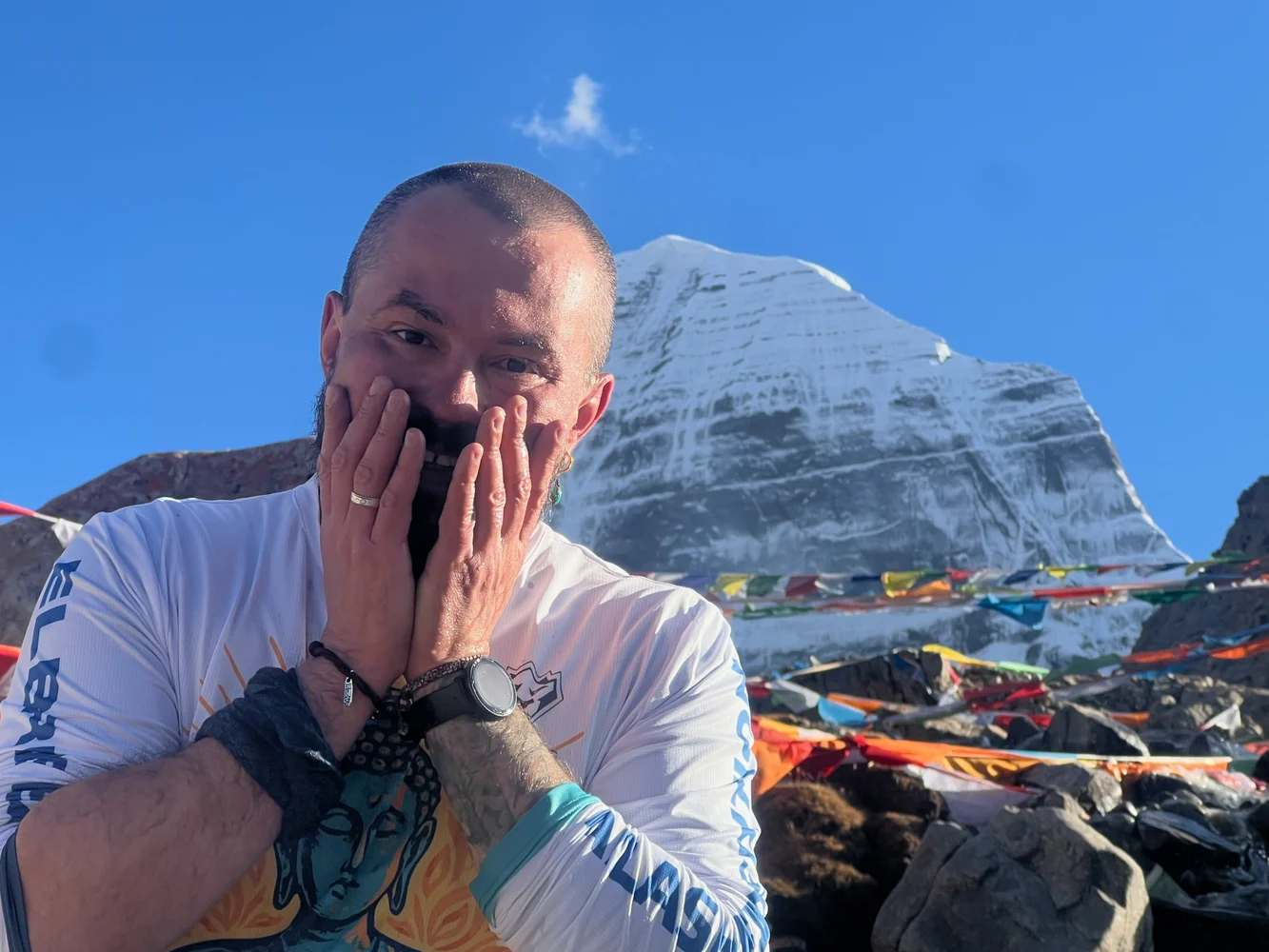
Terma on the way. A guide to "insights" in Tibet
What is terma in Tibetan Buddhism and who are the tertöns? How the tradition of "hidden treasures" helps us understand Tibet, the Kailash kora and ourselves more deeply.
What terma is and why Tibet turned the landscape into a book
How tertöns discovered treasures in the past
Where might your "terma" turn up on the route?
A short explanation
In Tibetan Buddhism terma means a special tradition of obtaining secret spiritual "treasures" (texts, revelations or relics) that were hidden in the past and discovered at a suitable time by tertöns — recognised discoverers of the "hoards" of the Buddhist teaching.
Terma is not just a good thought, a chance find or a sudden inspiration. In the traditional account of the Nyingma school, such teachings and objects were concealed — above all by Guru Padmasambhava himself and his circle — so that they could later be discovered at the right historical moment. Academic studies regard terma at once as a form of religious revelation, a means of legitimising new texts and a particular way of looking at the Tibetan and Himalayan landscape as a repository of the past.
A respectful note. We use the term neither carelessly nor literally. In this guide the expressions "your terma", "finding a terma on the path" and "the traveller's insight" are no more than literary and practical metaphors denoting the intention and meaning of a journey. We do not equate a tourist with a tertön, an ordinary psychological insight with a religious revelation, or a hike with tantric practice. For believers of Nyingma and followers of Bon, terma is part of a living sacred tradition. By our text we in no way wish to mock it, devalue it or appropriate it. On the contrary, a good metaphor begins where a person understands its limits.
On a trek or a kora, a traveller does not need to hunt for Padmasambhava's scroll under every stone. It is far more interesting to ask what "hidden treasure" the path itself uncovers. It may turn out to be an understanding of your own fear on a pass, the unexpected kindness of a stranger, the ability to sit calmly through the rain, a silence in a monastery courtyard, or the simple discovery that for the last three hours you have been thinking only about coffee.
The main idea of this guide is simple. Historically, a tertön sought what, according to tradition, had been hidden until a certain time. A modern traveller may seek not a sacred terma but something hidden in themselves, invisible until the road made them see it.
And there is one more rule worth remembering before you set out. If you find an ancient scroll, a statuette or a ritual object in a cave, it is not your "terma". In that situation you must stop being a poet, touch nothing and turn to the keepers of the place.
What terma is and why Tibet turned the landscape into a book
The word gter ma is usually translated as "treasure". The scholar Janet Gyatso has shown that the Tibetan terma tradition became a way for new authoritative texts to appear after the great era of translating Indian Buddhism into Tibetan. According to the Nyingma internal tradition, Padmasambhava and other teachers of the era of the Tibetan Empire hid instructions for future generations, and the tertön destined for this had to reveal them when they would be especially needed. Gyatso also stresses that treasures were created and recognised by both Buddhist and Bon communities, between which there was mutual influence.
What is especially interesting in this view is the landscape. A cliff, a temple, a gorge and a hidden valley can be perceived as places in which the past continues to be present. In an academic study of Tibetan treasures this is described as a special form of the "materialisation of the past", in which teachings and sacred objects are thought of as hidden in Tibetan and Himalayan space until the right time comes and the right person appears. Moreover, the concept of "treasure" could historically include not only texts but also ritual objects, images, relics, medicines, dances and even whole hidden lands.
That is precisely why the idea of terma goes so well with travel. Here the route becomes a way of reading space. A modern tourist usually looks at a map and sees point A, a pass, an overnight stop and point B. A pilgrim may perceive the same landscape differently. The place has a history, a memory and a connection with teachers. Pilgrimage turns geography into experience. Studies of the Tibetan sacred landscape show that remoteness, mountains and places of practice continue to play an active role in modern Tibetan religiosity.
From here comes the first useful thought for a traveller.
Do not ask your guide only what there is to see here. Ask (yourself too) what this place offers to show you about you.
Earth treasures and mind treasures
In traditional classifications it is especially convenient to distinguish two kinds. Earth termas (sa gter, or sater) are associated with the physical discovery of texts and objects. Mind termas (dgongs gter, or gongter) are revealed in the tertön's consciousness. More complex classifications also include rediscovered treasures, recollections, pure visions and oral lines of revelation, so it would be inaccurate to automatically call any vision a "mind terma". The Tibetan tradition itself distinguishes these modes of transmission quite carefully.
For the tourist metaphor this gives two wonderful categories.
The "traveller's earth terma" is what comes from outside. You went round a bend and saw a valley. You met an old pilgrim, heard a prayer, read an inscription. You saw locals repairing a bridge, or suddenly understood how life works in the place you have come to.
The "traveller's mind terma" is what is unexpectedly discovered inside. For example, after four hours of climbing a person realises that his famous love of solitude exists perfectly well only as long as someone else is carrying the heavy rucksack.
And what about Bon?
Here it is especially important not to reduce Bon to the word "shamanism". Modern study of Bon shows a far more complex history. The tradition of treasures became significant for Bon as well, and a monograph by the Tibetologist Dan Martin is devoted precisely to the life and disputed legacy of Shenchen Luga, an 11th-century Bon discoverer of scriptures. The existence of parallel Buddhist and Bon treasures, and of mutual polemic and influence, is well documented by researchers.
So terma is interesting not as proof that one religion "took" something from another. It is far more interesting to see here a Tibetan cultural idea according to which truth can be bound to a time, a person and a place, and be revealed when these three meet. For a traveller this is almost a ready-made formula for a route: place + the right moment + an attentive person = the possibility of seeing something. Not necessarily the supernatural. Sometimes it is enough to see yourself.
How tertöns discovered treasures in the past
Let us dispel at once one pretty tourist mistake. It is wrong to imagine that in old Tibet there was a special squad of monks with pickaxes who went from cave to cave asking whether Padmasambhava might be there.
Tertöns were not necessarily monastics. The biographical database Treasury of Lives defines tertöns as people who discovered scriptures or objects by means of visions, memory or physical extraction. Among them were monastery teachers, yogis and laypeople — both men and women. The famous Pema Lingpa, for example, trained as a blacksmith. Jomo Menmo was a woman tertön of the 13th century.
And the "treasure hunt" itself usually looked more complicated than a chance stroll.
In traditional biographies a future tertön might receive a prophecy, a dream, a vision, a special sign or an indication of a place. There might be a kind of key or a description of the future discovery. Then came religious preparation and work with a text or a symbolic script. After that the person set off to a specific place, which might be a cave, a rock, a temple, a lake or another sacred space. What was found still had to be recognised, read, unsealed and passed on. The history of the tradition also shows that the question of the authenticity of termas was important to Tibetans themselves and was discussed long before modern academic scepticism appeared. Interestingly, a modern traveller can adopt almost the same structure without appropriating anything from religious practice.
Question → Preparation → Path → Attention → Insight → Testing by life.
This is exactly the approach we teach in our Guides' School.
Four little stories about great treasures
Pema Lingpa and the lake a tourist should not dive into.
Pema Lingpa, who lived in Bhutan in the 15th and early 16th centuries, trained as a blacksmith and became one of the most famous tertöns. The place Mebar Tso, known as the Burning Lake, is linked with a traditional account of how he entered the water and brought out a treasure. In a later version of the story, before sceptical witnesses, he entered the water with a burning butter lamp and returned with the treasure, the lamp still burning. A modern Bhutanese travel essay shows that this story is still part of pilgrims' perception of the place today.
For a traveller the moral is unexpectedly practical. Not everything a saint did in his biography is an instruction for a tourist. Especially jumping into a mountain river.
Jomo Menmo and a useful breaking of a stereotype.
Jomo Menmo, who lived in the 13th century, is among the recognised tertöns of Nyingma; her biography is linked to Guru Chöwang, one of the famous early treasure discoverers. The very fact of her presence in the tradition is a reminder that the image of the tertön cannot be reduced to a male monk sitting in a monastery library.
For a traveller the moral is even simpler. If you decide in advance what the person from whom an important thought will come should look like, you can simply fail to notice half of the important encounters.
Guru Chöwang and medieval fact-checking.
Guru Chöwang, who lived in the 13th century, was one of the greatest early tertöns. Janet Gyatso's study shows that the treasure tradition was already confronting the question of authenticity, and the texts connected with Guru Chöwang discussed the signs and grounds by which an authoritative discovery could be distinguished from a dubious one.
This is very healthy news for a modern person. Even in the world of revelations there was the question "and how do we know it is true?" So if after two hours at an altitude of 4500 metres an exhaustive explanation of how the Universe works comes to you, you can write it down in a notebook. But it is better to draw final conclusions after breakfast.
Jigme Lingpa and the treasure that does not need digging up.
Jigme Lingpa, who lived in the 18th century, is considered a Nyingma tertön and is associated with the discovery of the Longchen Nyingtik cycle. He found it within himself. Here a religious insight really did take place — that very "mind terma", in which a discovery is linked not with extracting an object from a rock but with an inner revelation and the subsequent transmission of the teaching.
For a traveller a wonderful anti-Instagram rule follows from this. Sometimes the main thing you bring home from a journey cannot be photographed.
Was the kora around Kailash a way of seeking termas?
The kora is a ritual circumambulation of a sacred place or object, a form of pilgrimage. It would be wrong to turn it into a standard "treasure-hunting technology". But terma and kora meet in one cultural space. Both practices assume that certain places can have special religious significance, and that a person's movement through a sacred landscape can change their perception. So on the kora, and even on the way to it, there may be a place connected with a tertön or a terma, but the kora itself is not the Tibetan version of the game "Find the Treasure". This distinction is best kept in mind, especially when people for whom this is not a cultural excursion but a prayer are walking nearby.
Where might your "terma" turn up on the route?
The most interesting thing in a journey happens at the moment a person stops waiting for insight. On a real path it has a nasty habit of appearing where it is not ordered. You paid for a sunrise over the Himalayas, and you made your main discovery next to the toilet at the second camp. It happens.
As a guide, I suggest a schematic but very workable approach to preparing the psyche for any journey. It consists of three parts. We tell you more in the Guides' School.
A question at the start
Begin at the start, when you are still clean and fresh, the rucksack is packed perfectly, the photos are lovely and it seems you have set off "to meet yourself". Ask one question: "What do I want to get from this journey?" And then a second: "What will happen if the journey gives me something quite different?" This will be your first mindfulness practice.
Thirty seconds without doing anything
At a sacred cave a modern person's first impulse is very simple — to have a photo taken, and the second is even simpler — to take a little stone as a keepsake. And that is normal, but here a wonderful practice arises. Do nothing for thirty seconds. Just look. What happens when a place exists not as a backdrop for your photograph but in its own right? That may become your metaphorical terma. The ability not to appropriate.
Seeing a person
Sometimes the most important event of the day turns out to be not a place but a person. You see an old woman walking more slowly than you. An hour later you overtake her. Two hours later you are sitting exhausted while she calmly walks past. You do not have to conclude at once that traditional wisdom is superior to your way of life. A trip in the mountains is quite good enough as it is at humbling human self-esteem.
On the kora around Kailash, for example, researchers have observed pilgrims who had walked the route many times. Some made the circuit with full prostrations. There too, Buddhist and Bon pilgrims follow different directions of circumambulation. This reminds the tourist that one and the same trail can be a route for them and a sacred road for the person beside them. So there is one practice here: before photographing a person, try simply to see them.
And one more myth worth dispelling. The strength of an emotion is a poor criterion for a real insight. Another is much more accurate: whether anything remains a month later. So after a journey it is useful to write three more lines.
What I saw.
What I understood about myself.
What of this will change my behaviour at home.
If the third line is empty, perhaps it was merely a beautiful experience. There is nothing wrong with that. Not every cloud has to be a revelation.
A map of the places where a "terma" may be met
This is not a map of religious termas. It is a diagram of possible moments of personal discovery.
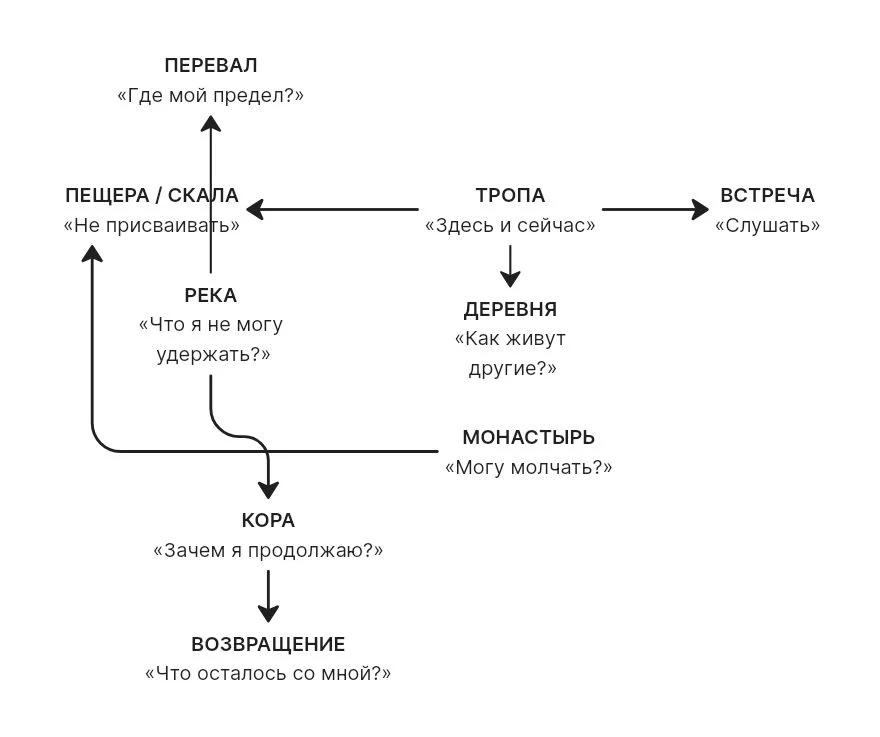
Note the strange feature of this map. It has no point marked "INSIGHT". Because if you designate the place of insight in advance, it turns into a tourist attraction. Real discoveries have a poor relationship with schedules.
We will find a route for you
Tell us what interests you — and the destination expert will get in touch, answer your questions about altitude, timing and preparation, and suggest a suitable programme. The consultation is free and commits you to nothing.