

How to Travel to Tibet in 2026: Without a Visa, but With a Permit
You cannot visit Tibet on your own—only through a travel agency and as part of a group. What documents are required, and how long does the application process take?
What documents are required to obtain a permit to enter Tibet?
How long does it take to process the paperwork?
Risks You Should Be Aware of in Advance
What if we went through Nepal? An alternative scenario
The Tibet Autonomous Region (TAR) is closed to independent travel. You won’t be able to buy a ticket, fly there, and figure things out once you arrive. You can only enter Tibet through a licensed travel agency and as part of an organized group. A package of permits must be arranged in advance, and the itinerary must be approved.
What documents are required to obtain a permit to enter Tibet?
A passport valid for at least 6 months from the end date of the trip.
"Visa-Free Travel": You won't need to apply for a visa at the consulate. Russians can travel to China visa-free for up to 30 days. This arrangement was introduced in 2025 and extended through December 31, 2027.
Permit Information: All permits are processed remotely using a scanned copy of your passport. To begin the process, you must submit a clear copy of the first page of your passport, specify the exact dates of your arrival in and departure from Tibet, and indicate the city in China through which you plan to enter. It is recommended that you provide your ticket information right away. Due to the specific requirements for processing permits, the group should, if possible, fly to China and Lhasa on the same flights. If you plan to purchase tickets at a later date (as agreed), you must still provide the dates and city of entry immediately—without this information, the application process cannot begin.
Health Insurance: You’ll need a policy that covers the entire trip, and for the trek around Mount Kailash, you’ll need separate insurance for trekking above 3,500 meters. It’s best to arrange this with a few extra days’ coverage in case of bad weather or an unexpected change in the itinerary.
What does the agency handle?
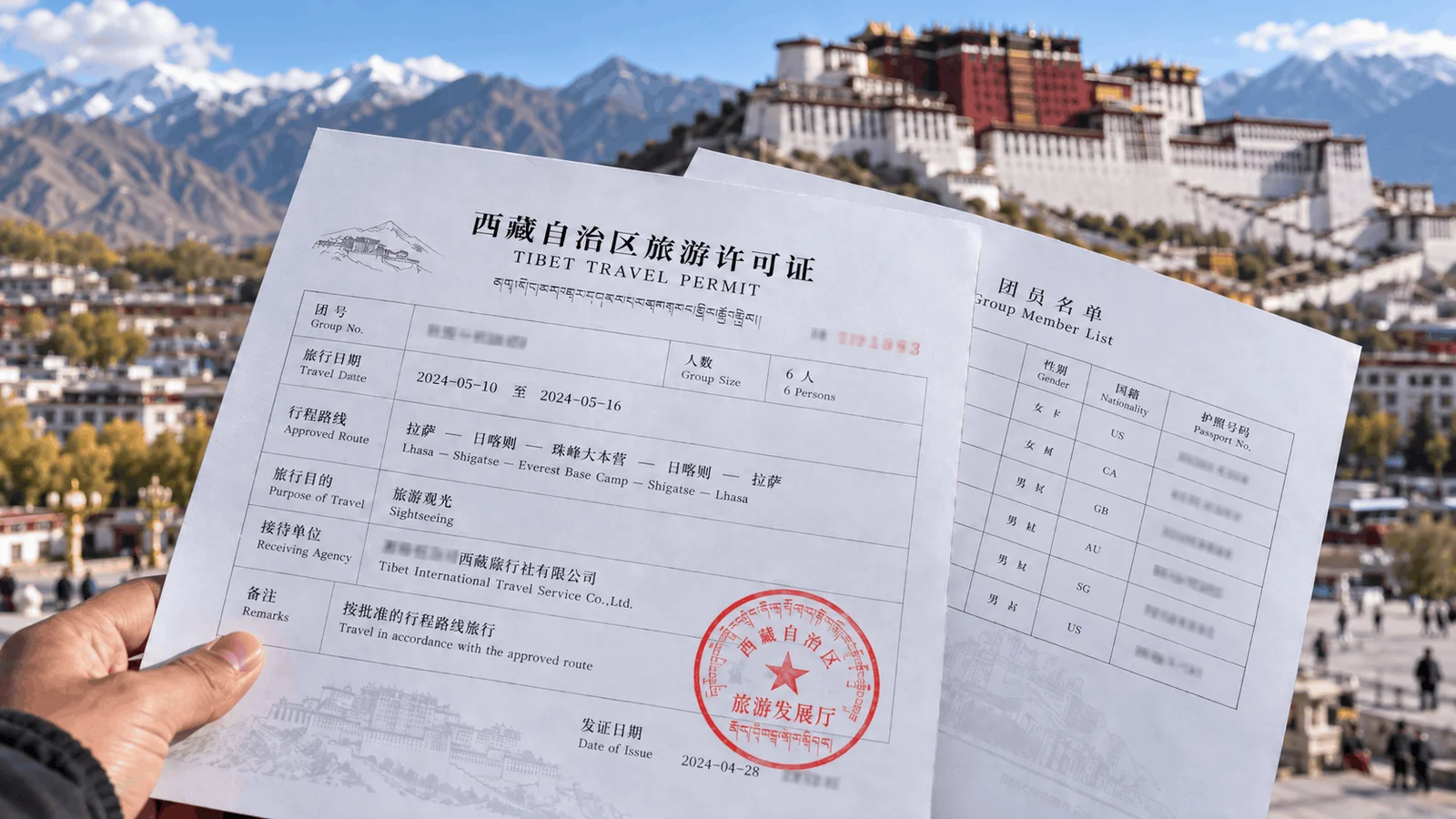
The most important thing is the so-called Tibetan permit, or the Tibet Travel Permit (TTP) issued by the Tibet Tourism Bureau. This is not a stamp or a page inserted into your passport, but a separate document. Without the physical original, you will not be allowed to board a plane or a train to Lhasa. A printed copy of the permit (sent to you before the tour) is also required to board a flight to China and to exit the transit area.
In addition, to travel to Everest Base Camp and the sacred Mount Kailash, you need additional special permits: a permit to visit restricted areas (Aliens Travel Permit) and a military permit (Military Permit). These are issued by the host party at our request.
Original permits are not mailed to participants' homes. Group members receive them immediately before their flight or departure for Lhasa. This is standard practice, and the documents are handed over in one of the following ways:
At Chengdu Airport before the flight to Lhasa. A representative holding a company sign personally hands over the document in the arrivals hall.
At a hotel in another city in China. If you plan to stay overnight during a long layover, the permit will be delivered to the front desk free of charge.
If you’re planning your own itinerary through Beijing or another city in China, paid delivery is available. It will cost approximately 70 USD—the exact amount depends on the number of participants and is arranged separately with the Chinese agency.
How long does it take to process the paperwork?
A comfortable timeframe for planning a trip is 1.5–2 months before departure. Documents must be submitted to the Tourism Bureau at least 20–30 days before entry (especially for restricted areas such as Mount Kailash). In some cases, it is possible to process the paperwork on a tighter schedule, but this requires separate coordination with the Chinese agency and depends directly on its workload and the specific dates of the trip. The nearest departure dates are in the tour schedule.
Logistics Within Tibet
Participants must be accompanied by a local Tibetan guide and an accredited driver along the route. This is not merely an option, but a strict legal requirement. A Russian-speaking tour leader also accompanies the group throughout the entire trip. He coordinates all aspects of the trip and is responsible for the group’s overall comfort.
Risks You Should Be Aware of in Advance
High-altitude routes in Tibet have their own unique characteristics. Occasionally, access to the Mount Kailash region or to Everest Base Camp may be temporarily closed without warning—for both foreigners and locals. This usually happens due to bad weather for safety reasons or on the eve of commemorative dates and holidays. There’s no need to panic. We are aware of this possibility and always build in buffer days into our itinerary. If access is blocked, the trip will not be canceled: the trek can be rescheduled within the tour, and in the worst-case scenario, the trip will be rescheduled without any loss of payment.
What if we went through Nepal? An alternative scenario
Entering via mainland China is the most common and convenient route. However, a trip to Tibet can be combined with a trip to Nepal. This option, which involves entering via Kathmandu, is discussed and arranged on a case-by-case basis.
FAQ: Tibet 2026
Do I need a visa for China?
No. Russians are eligible for a visa-free stay of up to 30 days—through December 31, 2027.
What is a Tibet Travel Permit?
The Tibet Travel Permit (TTP) is a separate document issued by the Tibet Tourism Bureau. Without the original, you will not be allowed to board a plane or train to Lhasa.
What documents are required to apply?
A scan of the first page of your international passport (valid for at least 6 months), entry/exit dates, and the city of entry into China. It is recommended that you send your ticket information right away.
Is medical insurance required?
Yes, for the entire tour. For the Kailash circuit, separate insurance is required for trekking above 3,500 m, with coverage extending several days beyond the trek.
When is the original permit issued?
Before departure to Lhasa. Possible scenarios: at the Chengdu airport, at the hotel during an overnight stay, or via paid delivery (~70 USD).
How long does processing take?
A comfortable timeframe is 1.5–2 months. At least 20–30 days before entry (especially for restricted areas).
Can I travel independently?
No. The TAR is closed to independent tourism—travel is permitted only through a licensed agency and as part of a group.
Who accompanies the group on the route?
A local Tibetan guide, an accredited driver, and a Russian-speaking tour leader—required by law.
Can access to Mount Kailash or Mount Everest be closed?
Yes, sometimes without warning—due to bad weather or before holidays. The trip is not canceled: the itinerary is adjusted or rescheduled without any loss of payment.
We will find a route for you
Tell us what interests you — and the destination expert will get in touch, answer your questions about altitude, timing and preparation, and suggest a suitable programme. The consultation is free and commits you to nothing.